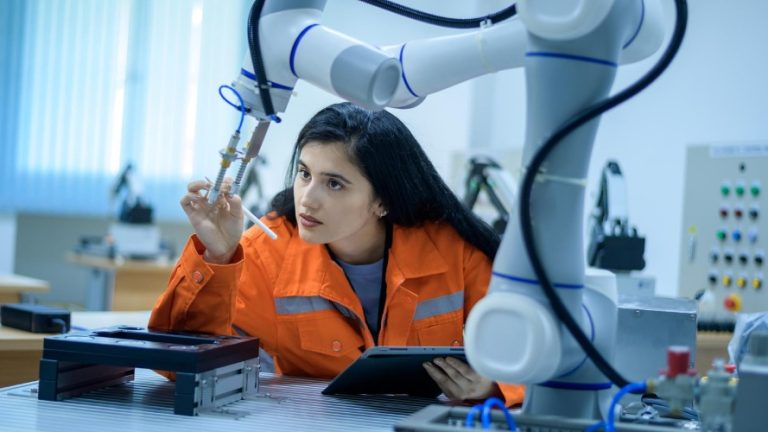
Top Women Leading the Robotics Revolution: Pioneers Advancing AI, Automation, and Intelligent Machines
Factory floors were once robotics’ primary domain. Not anymore. Today, robots are transforming hospitals, warehouses, farms and even space missions. As AI becomes increasingly integrated into their capabilities, robotics is evolving far beyond the industrial automation it was built around.
Women are playing a growing role in that transformation. Researchers, engineers, entrepreneurs and executives are not simply participating in robotics—they are helping shape the direction of intelligent machines and defining where the technology goes next.
1.Daniela Rus
Daniela Rus runs MIT’s Computer Science and Artificial Intelligence Laboratory, and her research has stayed focused on autonomous systems and collaborative robots – machines built to work alongside people, not replace them outright.
2.Cynthia Breazeal
Social robotics as a serious research field owes a lot to Cynthia Breazeal, whose work centres on robots that communicate and interact with people in ways that actually feel natural rather than obviously scripted.
3.Ayanna Howard
Ayanna Howard’s research in intelligent and assistive robotics asks a more grounded question than most of the field: how can robots and AI genuinely support people in healthcare, education, and everyday settings robotics research usually skips over.
4.Fei-Fei Li
Computer vision is where Fei-Fei Li has made her mark, shaping how machines actually perceive what’s in front of them – arguably one of the hardest problems standing between a robot and sensible behaviour in the real world.
5.Radhika Nagpal
Radhika Nagpal is a researcher in collective robotics, inspired by biological systems to understand how groups of robots work together to accomplish things that no single robot could do alone.
6.Anca Dragan
Anca Dragan works at the intersection of human-robot interaction and machine learning, focused on teaching robots to read human intent well enough to operate safely around people – not just near them, but genuinely with them.
7.Nadia Thalmann
Humanoid robots and virtual humans are Nadia Thalmann’s territory, and her work has pushed forward how machines behave and communicate in ways that read as natural – a corner of robotics that’s arguably as much psychology as engineering.
8.Sabine Hauert
Sabine Hauert’s focus is swarm robotics: small robots working in groups to solve problems too big for any one machine, with real applications in search-and-rescue and environmental monitoring already taking shape.
9.Kristen Grauman
Kristen Grauman’s work in computer vision feeds directly into how robots recognise objects, navigate space, and respond to what’s actually happening around them – the perceptual groundwork most robotics applications quietly depend on.
10.Regina Barzilay
Regina Barzilay sits at the crossing point of machine learning and healthcare, using intelligent systems to support work like medical discovery – a useful reminder that AI and robotics’ biggest impact isn’t always a physical machine at all.
Where This Leaves Robotics?
Research, engineering, entrepreneurship, leadership – women are shaping the robotics revolution across all of it, pushing the field toward machines that operate more intelligently, more safely, and more collaboratively than earlier generations managed. As robotics keeps fusing further with AI and automation, women bringing strong technical and creative range look set to keep shaping where it heads next.