


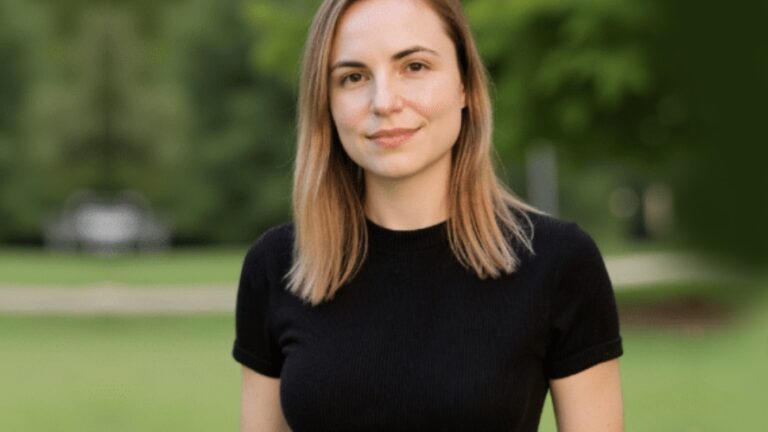
How LYRO Robotics Co-Founder Nicole Robinson is Reshaping Agricultural Automation
For most people, packing an avocado into a box may seem like a routine task. For a robot, however, it can be a complicated exercise involving precision, pressure and the ability to recognise differences in shape, size, and ripeness. This is the challenge Nicole Robinson set out to address when she co-founded LYRO Robotics, an Australian technology company developing robotic solutions for the food industry.
Robinson’s work focuses on bringing artificial intelligence and robotics into an area of agriculture that has largely depended on manual labour: sorting and packing fresh produce. Through LYRO, she has worked towards developing machines that can handle delicate fruits and vegetables, helping food businesses improve packing operations while addressing labour shortages.
Her journey from academic research to building a robotics company also reflects how emerging technologies are finding applications in industries beyond traditional manufacturing.
Academic Research to Robotics
Robinson’s fascination with robotics came from her studies at Queensland University of Technology (QUT), where she earned her Ph.D. studying human-robot interaction.
The focus of her study was on the interactions between people and robots, what affects their acceptance of working with machines, and how robotics can be used in practice.
Among other fields, she contributed to social robotics, human-robot interaction, and robotic vision. One of Robinson’s significant academic achievements is her paper that was published in the journal Science Robotics in 2018. The study was devoted to people’s interactions with social robots.
Through this research, Robinson gained an insight into the difficulties associated with the practical application of robots outside laboratories. It was also the way she came to realize another key question: How can robotics go beyond the research stage and help to solve problems faced by companies on a daily basis?
How LYRO Robotics Started?
Robinson met roboticist Dr Jürgen (Juxi) Leitner in 2017. Their shared interest in robotics and its commercial potential eventually led to discussions about developing technology for practical applications.
Robinson had also participated in the Amazon Robotics Competition in Japan, where she presented a robotics solution. Her experience, combined with Leitner’s work in robotic vision, helped shape the idea behind their venture.
In 2019, the two co-founded LYRO Robotics in Brisbane, Australia.
They selected the task of packing fresh produce, which posed a number of challenges due to its nature. Unlike manufactured goods, produce comes in varying sizes, shapes, weights and textures, posing certain difficulties for robots working with it.
It often leads to the necessity of employing human labourers who perform repetitive tasks.
At LYRO, the goal was to design robotic systems capable of identifying various products and then picking and packing them precisely.
Why is it Hard for Robots to Pack Fresh Produce?
Handling delicate agricultural products without causing any damage to them is one of the major challenges facing the robotics industry in agriculture.
For example, avocados should be handled gently because too much pressure causes bruises. The robot needs to recognize the fruit, choose the way to grip it and place it in the proper position without applying unnecessary pressure.
LYRO solves this problem using artificial intelligence, computer vision and robotic arms. Its systems use cameras to identify individual produce items and gather information about their shape and position. The software then helps determine how the robotic arm should pick up and place each item.
The technology is not limited to avocados. LYRO has developed applications for handling products such as zucchinis, sweet potatoes, capsicums and pineapples.
The broader objective is to make robotic packing more adaptable, rather than requiring businesses to purchase an entirely different automation system for every type of produce.
Taking the Technology to Commercial Farms
Developing a robot that works in a laboratory is one thing. Making it operate reliably inside a busy commercial packing facility is another. LYRO’s systems are designed to work in existing agricultural packing environments, where speed, consistency and reliability matter.
The company has also adopted a Robot-as-a-Service model, allowing businesses to access robotic automation without necessarily making a substantial upfront investment in equipment.
Its first customer was Sunnyspot Packhouse in Queensland in 2020. According to a 2024 report by Qantas Travel Insider, LYRO’s robots could handle up to 1,250 individual objects an hour. The publication also cited potential improvements of up to 500% in packing-shed throughput, based on figures reported by the company.
LYRO raised A$1.5 million in seed funding in 2022, with investors including AgFunder and Japanese machinery manufacturer Toyo Kanetsu. The funding was intended to support the development and deployment of its robotic packing technology.
Tackling Labour Shortages and Food Waste
For Robinson, however, the potential of agricultural robotics is greater than merely cutting down on the labor needed for packing fruits and vegetables. Producers of foodstuffs have to deal with several difficulties, such as labor shortages, increasing costs, and the need to process and distribute perishables fast.
If packing plants fail to process the harvested foodstuffs in a timely manner, producers can experience delays or even incur losses. Automating the process via robotic technology can be seen as a solution. With the help of automation, the goal of LYRO is to facilitate the processing and movement of fresh produce out of farms and into supply networks.
This topic was raised by Robinson during an interview that took place in August 2022 with AgFunderNews. The company’s focus remains on specific handling and packing processes. Its technology is not a solution to food waste across the entire supply chain, but it aims to address one of the operational stages where automation can make a difference.
Taking LYRO Beyond Australia
As the company developed its technology and commercial operations, its ambitions extended beyond the Australian market.
LYRO began exploring opportunities in international markets, including the United States and Asia. Trade and Investment Queensland has highlighted the company’s export ambitions and its efforts to develop robotic solutions for different product categories.
Expanding internationally, however, involves more than introducing machines to new markets. Robotic systems must work with different products, packaging requirements and production environments while delivering measurable benefits to businesses. LYRO’s approach of developing adaptable robotic technology is central to this ambition.
Career at the Intersection of Research and Business
Robinson’s professional journey brings together academic research, robotics development and entrepreneurship.
Her background in human-robot interaction has informed her work on making robotic systems more useful in real-world environments. At LYRO, that experience has translated into a business focused on solving a specific problem in agriculture.
She has also remained connected to the wider technology and research community through academic collaborations and discussions around artificial intelligence and human-robot collaboration.
In 2024, she was recognised as the Women in AI APAC Grand Winner, according to her professional speaker profile. Her work has also been associated with efforts to encourage greater participation by women in science, technology, engineering and mathematics.
Leadership Change at LYRO Robotics
On November 3, 2026, LYRO Robotics announced a leadership change, appointing co-founder Norton Kelly-Boxall as its new CEO. The company acknowledged Robinson’s contribution to building the business and said she would remain involved and continue supporting the organisation.
The announcement marks a new phase for LYRO, which began in 2019 with the ambition of applying robotics to one of agriculture’s most labour-intensive activities.
Robinson’s journey highlights how research can translate into commercial technology when it is directed towards practical industry problems. At LYRO, that problem has been making machines capable of handling something as unpredictable as fresh produce.
The challenge is no longer simply whether a robot can pick up an avocado. It is whether it can do so repeatedly, without damaging the fruit, at the speed and consistency required by a commercial packing facility. That is the problem Robinson helped bring into focus through her work in agricultural robotics.


